191. Number of 1 Bits
Write a function that takes an unsigned integer and return the number of ‘1’ bits it has (also known as the Hamming weight).
Example 1:
Input: 00000000000000000000000000001011
Output: 3
Explanation: The input binary string 00000000000000000000000000001011 has a total of three ‘1’ bits.
Example 2:
Input: 00000000000000000000000010000000
Output: 1
Explanation: The input binary string 00000000000000000000000010000000 has a total of one ‘1’ bit.
Example 3:
Input: 11111111111111111111111111111101
Output: 31
Explanation: The input binary string 11111111111111111111111111111101 has a total of thirty one ‘1’ bits.
Note:
Note that in some languages such as Java, there is no unsigned integer type. In this case, the input will be given as signed integer type and should not affect your implementation, as the internal binary representation of the integer is the same whether it is signed or unsigned.
In Java, the compiler represents the signed integers using 2’s complement notation. Therefore, in Example 3 above the input represents the signed integer -3.
解读:
统计32位无符号二进制包含1的个数。
方法1
采用循环移位的方式,判断末尾是否为1.
代码如下:
class Solution {
public:
    int hammingWeight(uint32_t n) {
        int nums = 0;
        for(int i=0; i < 32; i++)
        {
            if(n &1 % 2 == 1)
                nums ++;
            n >>= 1;
        }
        return nums;
    }
};
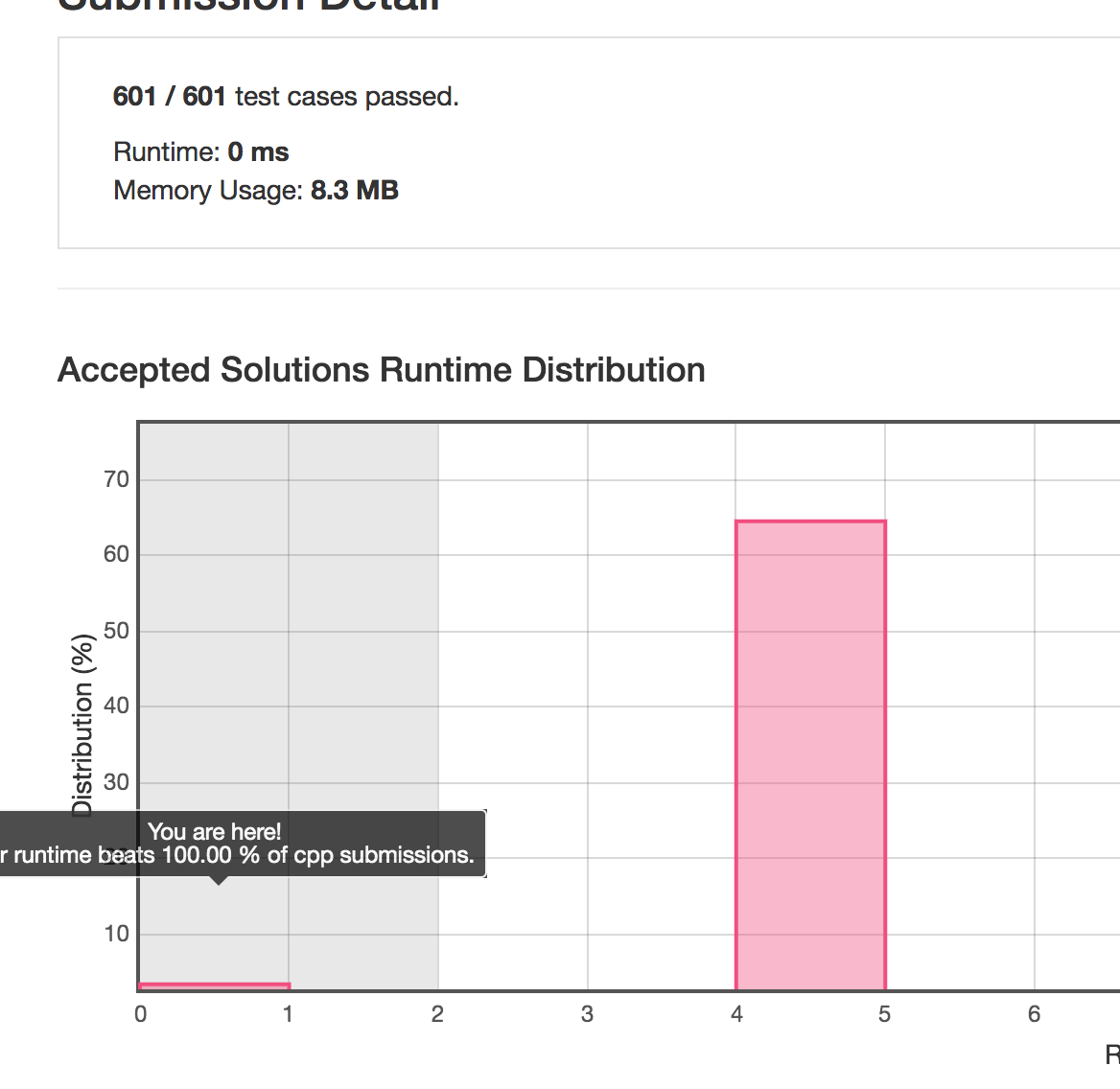
执行结果:
方法2:
class Solution {
public:
    int hammingWeight(uint32_t n) {
        int nums = 0;
        while(n)
        {
            n = n&(n-1);
            nums ++;
        }
        return nums;
    }
};
其中n&(n-1)每次处理都会把二进制中最低位的1去掉。
例如,二进制为:00101100
If n = 00101100, then n – 1 = 00101011, so n & (n – 1) = 00101100 & 00101011 = 00101000. Count = 1.
If n = 00101000, then n – 1 = 00100111, so n & (n – 1) = 00101000 & 00100111 = 00100000. Count = 2.
If n = 00100000, then n – 1 = 00011111, so n & (n – 1) = 00100000 & 00011111 = 00000000. Count = 3.

LeetCode 26.Remove Duplicates from Sorted Array

LeetCode 239. Sliding Window Maximum
LeetCode 190. Reverse Bits
About Author
