2020年3月7日
LeetCode 150. Evaluate Reverse Polish Notation
C++, LeetCode, 算法, 编程
0 Comments
Evaluate the value of an arithmetic expression in Reverse Polish Notation.
Valid operators are +,-,*,/ . Each operand may be an integer or another expression.
Note:
- Division between two integers should truncate toward zero.
- The given RPN expression is always valid. That means the expression would always evaluate to a result and there won’t be any divide by zero operation.
Example 1:
Input: ["2", "1", "+", "3", "*"]
Output: 9
Explanation: ((2 + 1) * 3) = 9
Example 2:
Input: ["4", "13", "5", "/", "+"]
Output: 6
Explanation: (4 + (13 / 5)) = 6
Example 3:
Input: ["10", "6", "9", "3", "+", "-11", "*", "/", "*", "17", "+", "5", "+"]
Output: 22
Explanation:
  ((10 * (6 / ((9 + 3) * -11))) + 17) + 5
= ((10 * (6 / (12 * -11))) + 17) + 5
= ((10 * (6 / -132)) + 17) + 5
= ((10 * 0) + 17) + 5
= (0 + 17) + 5
= 17 + 5
= 22
解析:计算逆波兰表达式的结果,逆波兰表达式数字在前,操作符在后。采用栈处理,如果是数字就入栈,如果是操作符则把前面的两个元素取出,进行对应的操作,然后再把结果存放进栈中,具体代码如下所示:
class Solution {
public:
    int evalRPN(vector<string>& tokens) {
        stack<int> st;
        for(auto& str : tokens)
        {
            if(str.size() > 1 || isdigit(str[0]))
                st.push(stoi(str));
            else
            {
                int second = st.top();
                st.pop();
                int first = st.top();
                st.pop();
                switch(str[0])
                {
                    case '+':
                        first += second;
                        break;
                    case '-':
                        first -= second;
                        break;
                    case '*':
                        first *= second;
                        break;
                    case '/':
                        first /= second;
                        break;
                }
                st.push(first);
            }
        }
        return st.top();
    }
};
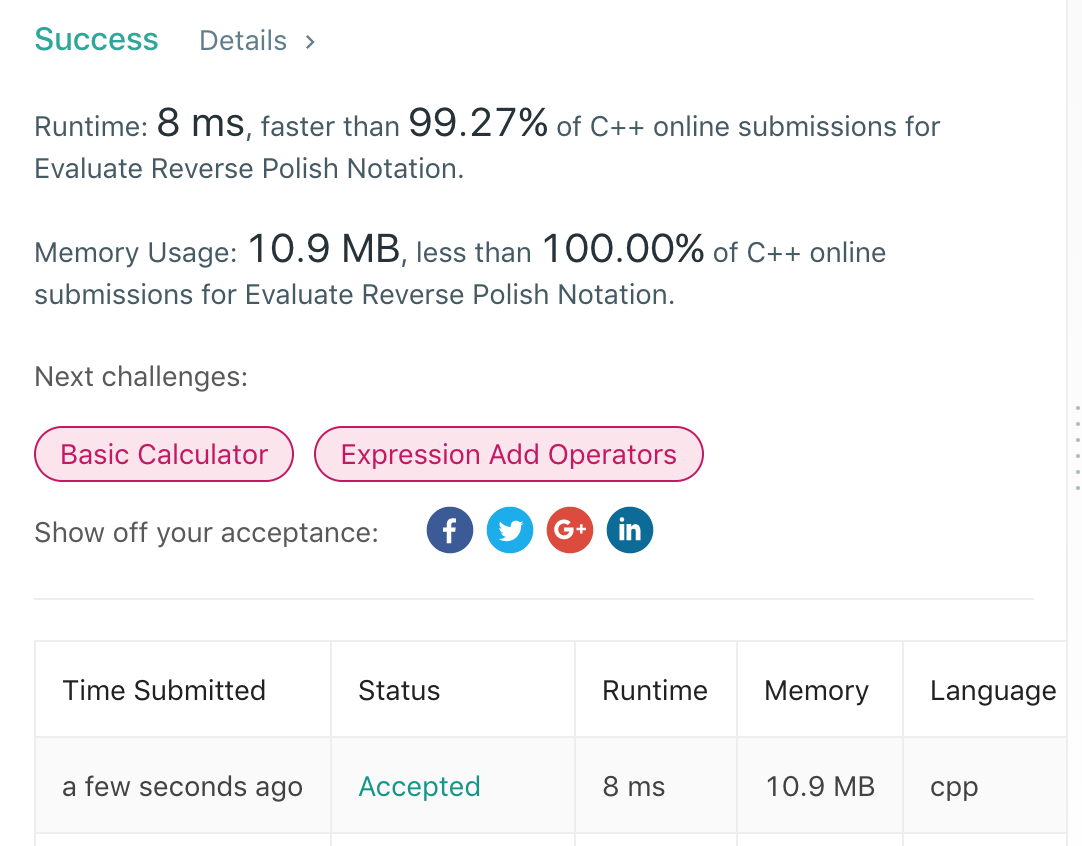
程序运行情况:



About Author
